What to Expect During Your Plastic Surgery Consultation

What to Expect During Your Plastic Surgery Consultation

It can be intimidating to reach out for help of any kind, let alone the kind that might involve discussing highly personal issues that you might be self-conscious about. But despite these real concerns, feelings of anxiety need not be part of a plastic surgery consultation. The creation of a safe space for open sharing without pressure and in a non-threatening environment are fundamental parts of your consultation.

It starts with an inviting and authentic culture of caring. We truly enjoy and believe in what we do, which we hope shows through to each new potential patient that comes in for a consultation. Next is getting to know you as a person to understand your specific reasons for reaching out for possible treatment. This helps us understand your goals. Some patients request a specific procedure or product first, which is sometimes reasonable, but we believe that most important is a mutual understanding of the goals you are trying to achieve and designing a customized treatment plan that can help you achieve them.

At Pacific Sound Plastic Surgery you are not pressured to undertake any procedure or treatment. We believe that providing information to potential patients, along with the options, risks, and benefits of each can inform and empower each person to make the choice that is best for them. There are many elements to consider when choosing an approach, whether they be recovery time, outcome expectations, cost, or other considerations. You will receive general information about each option and then transition into more specific details about the plan that sounds most in line with your goals.

Then comes the specifics, such as determining, for example, your preferred size of breast implant, the individual features of your face and neck you want to rejuvenate in your facelift, or the areas of wrinkling that you want Botox to address. We discuss the procedure itself. Dr. Kristopher Day enjoys drawing your surgery for you to help you visualize the process, as well as encourage further dialogue about the details of the recovery process, any activity limitations, special garments, drain cares, or other important details that follow your procedure. There is time for description of any insurance preapproval or out-of-pocket payment plan.

At your preoperative appointment, we review the information we have discussed and then explore any questions you might have. We also like to describe the surgical day check-in process and preoperative instructions so that there are less unknowns. We send prescriptions and make follow-up appointments before your surgical day so that you are most prepared and review medication and discharge instructions. A preoperative packet is completed before the surgical day so that all you need to do is arrive and go through the check-in process. We believe this allows you to focus on the important aspects of your recovery process, such as arranging whatever care provider, special cushions, or other resources might make you most comfortable.

The surgical and non-surgical experience in plastic surgery is a journey that starts with your consultation. Make sure that your surgeon and the practice you choose is focused on you and your well-being from start to finish. At Pacific Sound Plastic Surgery we are proud to put you and your goals first from the start of your consultation. So reach out to us today to learn what personalized care plan we can explore with you to achieve your goals!

Different Types of Neurotoxin

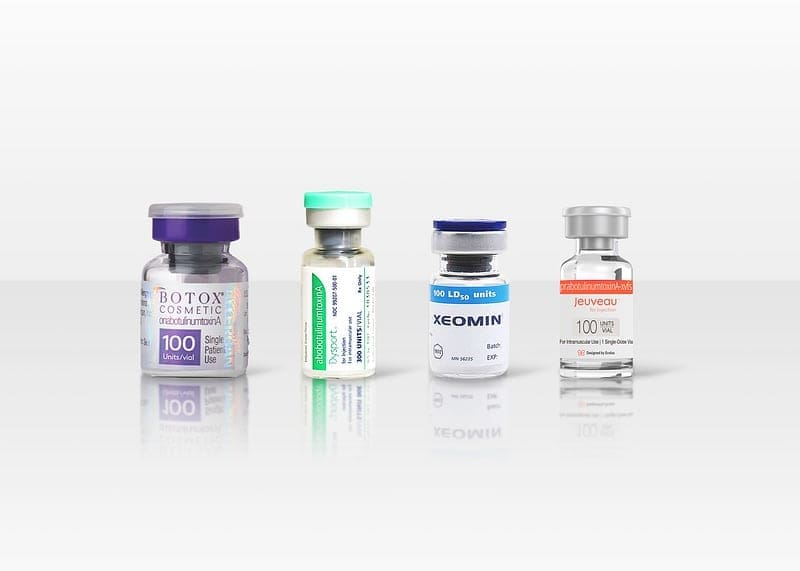
Botox-Dysport-Xeomin-Jeuveau

Different Types of Neurotoxin

The injection of toxin is the most common elective aesthetic treatment in plastic surgery. But sometimes there is confusion about what the treatment options are, various pros and cons, and the reasons to seek one neurotoxin over another. “Botox” is sometimes referred to the way “Kleenex” is referred to for tissues: a generic term for what is actually a brand name for one of multiple different neurotoxins used to treat wrinkles. This is probably because Botox is the original and most common agent used to paralyze facial muscles for the purpose of youthful rejuvenation. However, there are actually four different types of neurotoxin treatments, all of which are effective at reducing the appearance of wrinkles and fine lines. However, there are subtle differences between Botox, Dysport, Xeomin and Jeuveau. So here is some information that people often consider when selecting a neurotoxin treatment.

Our muscles rely on neurological signals to contract. Fundamentally, all neurotoxins work about the same when it comes to the treatment of fine lines and wrinkles (otherwise known as “rhytids”). Your brain tells muscles to contract through communication along nerve fibers with motor nerve endings that stop just before the muscle starts. If a muscle remains in a contracted state or repeatedly causes creases in the same location on the skin, then it can lead to the formation of wrinkles or fine lines or even pain (eg, headaches). Neuromodulators relax muscles and prevent their contraction by blocking neurological signals at the end of nerves. This, in turn, prevents the muscles from folding the skin repeatedly, and therefore prevents the formation of wrinkles.

Botox is a toxin made by Allergan that with a specific formula known as onabotulinumtoxin A. It’s injected directly into muscle tissue for the purpose of blocking neurological signals to the respective tissue. Dysport is made by Galderma and is an injection containing a different formulation, called abobotulinumtoxin A, which is also designed to block neurological signals to the targeted muscle tissue. Xeomin is produced by the German pharmaceutical company Merz Pharma GmbH & Co and uses incobotulinumtoxin A. Also known as “Newtox,” Jeuveau is made by Evolus and is an injection that uses botulinum toxin type A.

In terms of onset, Dysport is the fastest in as little as a few hours. Botox takes about 3 days, whereas Xeomin takes approximately 4 days to see the effects, which makes it the slowest onset, and Jeuveau is in between. All four types of injections have been approved by the U.S. Food and Drug Administration (FDA), but their approvals are each somewhat different. Botox was first approved in 2002 to treat moderate to severe facial wrinkles and is used on the forehead (upper transverse lines), glabella (lower vertical lines), and the lateral canthal area or “crow’s feet” lateral to the eyes. Dysport is technically only approved for glabellar wrinkles and cervical dystonia, since 2009. Since 2010, Xeomin has been approved for the treatment of blepharospasm and cervical dystonia. Jeuveau is approved for cosmetic purposes only. Both Botox and Dysport contain additives, which assist in the spread of product, but also require refrigeration, unlike Xeomin, which is stored at room temperature.

One of the benefits of having multiple different types of toxin to choose from is having options. Another is having alternatives in the setting of resistance. Over time, certain agents may become less effective due to the creation of antibodies by a patient’s immune system after repeat treatments. While this is rare, changing agents may be the best option if one’s primary treatment regimen becomes no longer effective.

In terms of the number of units used, Botox and Xeomin use similar amounts of approximately 20 units per treatment area for “full effect.” Dysport is generally twice as many units, though each unit costs less, which often offsets any difference in overall price. Jeuveau requires the most units of all four but usually costs the least per unit.

The summary is that Botox, Dysport, Xeomin and Jeuveau are all injections that paralyze muscles to prevent the formation of fine lines and wrinkles. The difference is the formula of the compound, which produces slightly different properties, but all create the effect of blocking neurological signals, paralyzing facial muscles, and decreasing wrinkles. At Pacific Sound Plastic Surgery we primarily use “name brand” Botox by Allergan but can obtain any of the four different products. If you’re interested in learning more about neurotoxin options or want to come in for treatment, simply reach out for your consultation!

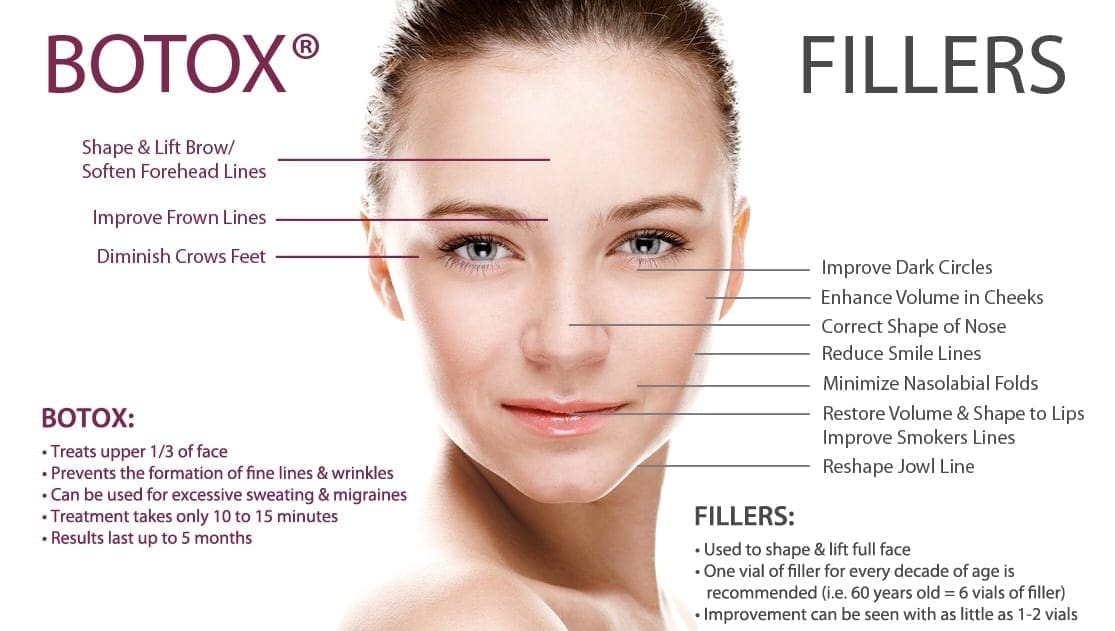
Botox and Dermal Filler “3-to-5 Rule”

Botox-Fillers-Dermatology

Botox and Dermal Filler “3-to-5 Rule”

We should start by saying that this rule-of-thumb is by no means scientific. It is just a way of summarizing the post-treatment counseling for patients after Botox and dermal filler in a way that is easy to remember. You will often hear different timelines, and some activities are important to avoid for longer periods of time. But no instructions are effective if you cannot remember them, so the “3-to-5 Rule” is what we find to help patients remember the timelines to expect after Botox injection. It goes like this:

  1. Hours: For 3-5 hours after your Botox or dermal filler injection, think “upright and lazy.” What does this mean? In more detail, this outlines several activities that could cause increased blood flow to the face and/or compression of the facial tissue that could either displace your product or increase the risk of bruising. These specific things to avoid include avoiding: Rubbing your face, lying on your face or lying down, strenuous exercise, alcohol intake, deep facial cleansing, heat and sun.
  2. Days: Often the results of neurotoxins are immediate. However, it may take up to 3-5 days to see complete paralysis of the muscles and relaxation of your expression. So it is important to remember to wait up to 3-5 days to see the effect of Botox or neurotoxin on your muscle movement. The corollary to this for dermal fillers is that, while we generally want to avoid bruising, it is possible to have bruising and initial swelling for up to 3-5 days. Lastly, if you take any blood thinners, it is best to avoid these (if considered safe by your prescriber) for at least one day before and after your injection.
  3. Weeks: If you receive treatment consistently with neuromodulators without a lapse in therapeutic effect, then there is likely no delay to the results you will notice on your wrinkles. However, if you haven’t been treated for some time, then it is possible that you will not see the results on the skin for 3-5 weeks after injection. Likewise, there are many dermal fillers, such as hyaluronic acids (HA; such as Juvederm and Restylane), PLLA/Sculptra, and others that volumize over time. Hyaluronic acid products recruit water to the site of injection over about 3-5 weeks, whereas Sculptra stimulates collagen production over greater than 3-5 weeks (more likely 6 weeks). So 3-5 weeks is a period of time that it is important to wait for the full effect of a neurotoxin on wrinkles or experiencing the full volume from a filler product.
  4. Months: Botox lasts approximately 3-5 months. Patients report variation in the duration of their neurotoxin results. Some with higher metabolism or higher activity lifestyles tend to claim their results resolve in 3 months, whereas others say they notice effects as long as 6 months. Allergan, the makers of Botox, recommends repeat treatment every 4 months. Other neurotoxins are different, such as Dysport, Xeomin, and Jeuveau, have different durations of action, and dermal fillers like HA’s generally last between 12-18 months, whereas Sculptra lasts approximately 24 months. So this part of the rule of thumb doesn’t typically apply to fillers or other paralytics. But, in general, the effects of Botox will last approximately 3-5 months.

Again, you will hear many different timelines for the above, and most of these are guidelines and not precise evidence-based principles. So take the above with a grain of salt. However, keeping the above Botox and dermal filler “3-to-5 Rule” in mind are all helpful guidelines to optimize results and inform expectations: 3-5 hours of restricted activities, 3-5 days to onset of effects, 3-5 weeks until full results, and 3-5 months for duration of treatment (Botox).

Call Pacific Sound Plastic Surgery today if you would like to explore Botox, Sculptra, Juvederm, or other neurotoxin or dermal filler treatment!