MOHS Reconstruction Surgery in Bellevue
Restore Your Appearance After Skin Cancer
MOHS reconstruction at Pacific Sound Plastic Surgery helps patients reclaim their appearance and confidence after skin cancer removal. When a MOHS surgeon removes skin cancer from the face, neck, or other visible areas, the resulting defect — regardless of size — requires expert surgical reconstruction to restore both function and aesthetics. Dr. Kristopher M. Day, MD, FACS, double board-certified and fellowship-trained in craniofacial and reconstructive surgery, works closely with dermatologic surgeons and MOHS specialists across the Bellevue and Seattle area to ensure every patient receives seamless, natural-looking results.
Double Board-Certified (ABPS + ABS)
Ivy League Trained
Highly Rated Bellevue Plastic Surgeon
Proudly Serving Bellevue, Seattle, Kirkland, Redmond, Mercer Island, Issaquah, Renton
What Is MOHS Reconstruction Surgery?
MOHS micrographic surgery is the gold standard for removing skin cancers on the face, ears, scalp, and neck. Because MOHS surgeons remove tissue layer by layer — examining each margin under the microscope before continuing — it achieves the highest cure rates of any skin cancer treatment. However, this precision comes with a practical reality: once the cancer is clear, a wound remains. That wound may be small or large, superficial or deep, and it often involves areas of the face where the skin does not simply stretch to close on its own.
MOHS reconstruction is the next step. It is the plastic surgery phase — performed by a reconstructive specialist, not the MOHS dermatologist — that transforms a surgical defect into a result that is both functional and cosmetically natural. At Pacific Sound Plastic Surgery, Dr. Day specializes in exactly this work: planning and executing reconstruction that heals cleanly, minimizes visible scarring, and restores the balance and symmetry of your face.
Who Performs MOHS Reconstruction?
MOHS surgery itself is performed by a fellowship-trained Mohs surgeon, typically a dermatologist with specialized training. The reconstruction that follows is performed by a plastic surgeon — ideally one with dedicated training in facial anatomy, tissue movement, and craniofacial principles. Dr. Day’s craniofacial fellowship gave him an advanced foundation in exactly the kind of complex facial tissue work that MOHS reconstruction demands.
Benefits of MOHS Reconstruction Surgery
Not all reconstruction is equal. The face is the most scrutinized surface of the human body, and a poorly planned closure can leave visible step-offs, distorted anatomy, pulled lower eyelids, or asymmetric lips. The choice of reconstructive technique — primary closure, local flap, advancement flap, tissue rearrangement, or skin graft — requires both surgical knowledge and an aesthetic eye.
Benefits of Expert MOHS Reconstruction
- Natural-looking results that blend with surrounding skin
- Preservation of facial function: eye closure, lip movement, nasal airway
- Minimized visible scarring through strategic incision placement
- Tissue-sparing techniques that honor the MOHS surgeon’s margin work
- Same-day or next-day reconstruction available in most cases
- Coordination with your dermatologist for a seamless care team
- Craniofacial training brings advanced anatomy knowledge to every repair
Am I a Good Candidate for a MOHS Reconstruction?
Most patients who have undergone MOHS surgery are candidates for reconstruction with Dr. Day. The key variables are the size and location of the defect, the tissue available nearby for closure, and the patient’s overall health.
- Good Candidates Include:
- Patients with recent MOHS surgical defect on the face, scalp, ears, or neck
- Patients referred by their MOHS surgeon for reconstruction
- Patients with defects of any size — from small excisions to large composite wounds
- Patients seeking cosmetically natural closure rather than simple healing by secondary intention
- Patients who were told reconstruction was “not necessary” but are concerned about cosmetic outcome
- May Need Additional Evaluation:
- Patients with active infection at the wound site
- Patients with significant uncontrolled medical conditions
- Patients on blood thinners (timing adjustment may be needed)
- Patients with prior radiation at the reconstruction site
- Patients with incomplete MOHS margins (reconstruction occurs after clearance)
Not Sure If You're a Candidate?
Schedule a consultation with Dr. Day to discuss your goals and options.
Your MOHS Reconstruction Journey
Step 1: Coordination With Your MOHS Surgeon
Reconstruction begins before the day of surgery. Dr. Day reviews imaging, photographs, and the anticipated defect with your MOHS team. In many cases, he can be available the same day as your MOHS procedure, allowing reconstruction to occur in a single visit under the same anesthesia or local block.
Step 2: Surgical Planning
Dr. Day evaluates the defect size, location, depth, and surrounding tissue mobility. He selects the technique — primary closure, local flap (such as a rotation, transposition, or interpolated flap), tissue advancement, or skin graft — that will produce the best cosmetic and functional outcome for your specific anatomy.
Step 3: Reconstruction
Most MOHS reconstruction procedures are performed under local anesthesia with or without sedation, in an outpatient setting. Procedure time ranges from 30 minutes for small repairs to 2–3 hours for larger composite defects involving the eyelid, nose, lip, or ear.
Step 4 — Recovery Timeline
Day 1
What to Expect
Light walking is encouraged starting the day after surgery. Keeping gently active supports circulation and healing. Avoid any activity that causes grimacing, straining, or elevated heart rate.
Week 1-2
What to Expect
Swelling and bruising peak around Days 2–3, then subside. Sutures removed (if non-absorbable). Desk work and sedentary activity typically resume in Week 1. Keep wound clean and moist as directed. Avoid strenuous physical exertion.
Weeks 2-4
What to Expect
Gradual return to physical baseline. Begin exertional activity at 50% of pre-operative level, increasing by approximately 5% per day. Light exercise typically cleared by Week 3–4.
Weeks 4-6
What to Expect
Full return to pre-operative activity level, including unrestricted physical exercise.
Month 1-3
What to Expect
Scar maturation begins. Redness fades and tissue softens.
Month 3–6
What to Expect
Majority of final scar appearance is established. Scar therapy products (Biocorneum) recommended.
12 Months
What to Expect
Final cosmetic result is typically visible by one year post-op.
Why Craniofacial Training Makes a Difference in Facial Reconstruction
Most plastic surgeons learn facial reconstruction during residency. Dr. Day went further: he completed a dedicated Craniofacial & Pediatric Plastic Surgery Fellowship — making him one of only a handful of surgeons in the Bellevue market with this specialized credential.Craniofacial surgery trains surgeons to think in three dimensions. The face is not flat — it has convexities, concavities, aesthetic units, and tension vectors that determine whether a repair heals beautifully or leaves distortion.
Craniofacial training develops the judgment to plan reconstructions that respect these principles: placing scars along natural lines, preserving the margin of the eyelid, restoring the curves of the nasal ala, and maintaining lip symmetry.
What This Means for MOHS Reconstruction Patients
- Incision placement based on relaxed skin tension lines — the same principles used in aesthetic facial surgery-
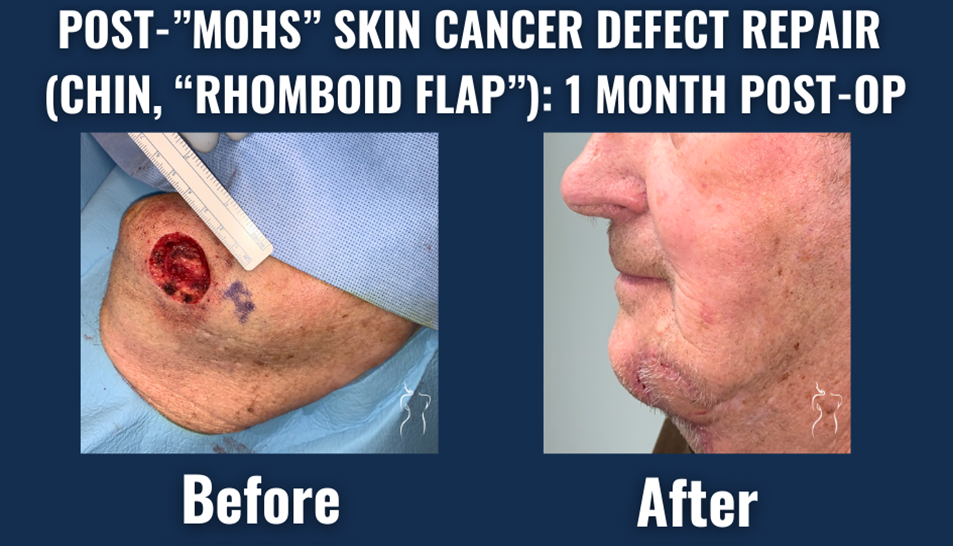
- Advanced flap techniques (Limberg, bilobed, rhomboid, Abbe, paramedian forehead flap) routinely performed, not occasionally attempted-
- Experience with complex periocular and perioral defects where anatomy is unforgiving
- Published research in craniofacial and reconstructive surgery (30+ peer-reviewed publications)-
- Understanding of tissue healing at the craniofacial level — skin, muscle, cartilage, and bone
What Results Can I Expect from a MOHS Reconstruction?
Realistic expectations are part of every consultation at Pacific Sound Plastic Surgery. MOHS reconstruction aims to achieve three things: a healed, closed wound; preserved facial function; and a cosmetically acceptable scar that, over time, becomes difficult to notice. While no reconstructive surgeon can guarantee that a scar will be invisible, skilled technique and thoughtful planning dramatically improve the final outcome compared to closure by the MOHS surgeon alone or healing by secondary intention.
Typical Outcomes by Defect Location
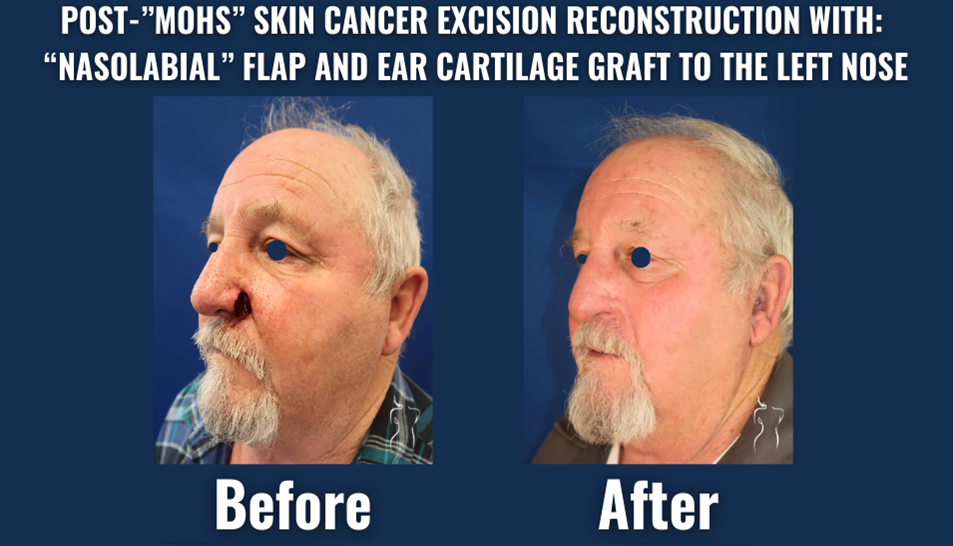
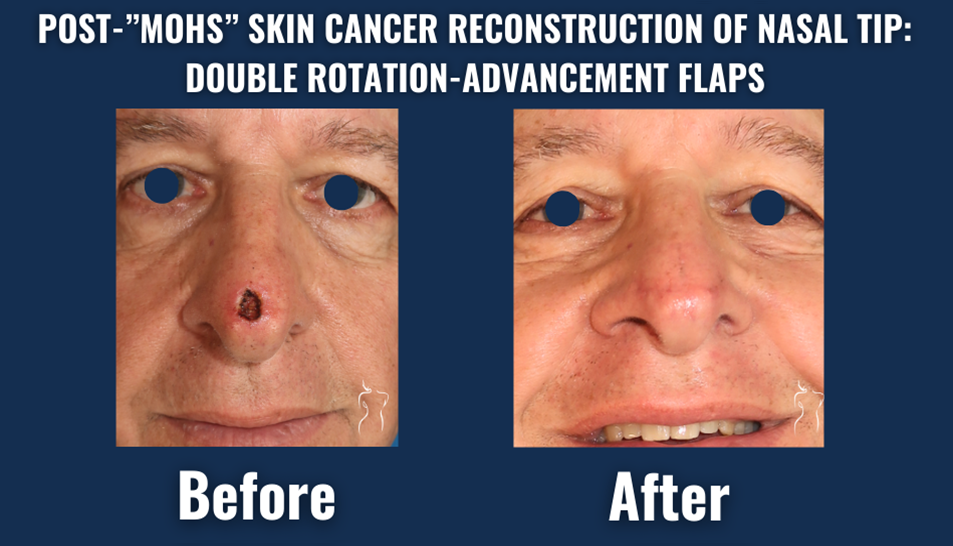
- Nose: Local flap reconstruction preserves alar rim contour. Paramedian forehead flap available for large tip/dorsum defects.
- Eyelid: Requires precise layered repair. Periocular expertise essential to avoid ectropion (lower lid pull).
- Cheek: Often closes with primary tension or rotation flap; scars frequently fall along natural facial creases.
- Ear: Cartilage-sparing repairs preserve shape. Composite grafts used when cartilage defect is present.
- Lip: Lip reconstruction preserves the vermilion border; specialized techniques maintain the philtrum and oral competence.
- Scalp: Often amenable to primary closure with wide undermining; rotation flap or skin graft for larger defects.
MOHS Reconstruction Cost in Bellevue
Insurance Coverage
- Most commercial health insurance plans cover MOHS reconstruction as a medically necessary procedure.
- Pre-authorization is generally required; our team handles this process on your behalf.
- If a cosmetic enhancement is combined with reconstruction, the cosmetic component may be billed separately.
What’s Included in Your MOHS Reconstruction Investment
Your surgical fee covers all of the following at Pacific Sound Plastic Surgery:
- Surgeon's fee
- Facility / operating room fee
- Anesthesia (administered by a board-certified anesthesiologist or certified registered nurse anesthetist)
- Enhanced Recovery After Surgery medication (Exparel)
- Cosmetic surgery insurance coverage (Cosmetasure)
- High-end compression garment (Isavella)
- High-end scar ointment (Biocorneum)
- Swelling and bruising ointment (Arnica)
- Clara Recovery Supplements
- Chlorhexidine Anti-Septic Scrub Cloths
- Post-operative recovery and follow-up care
Financing Options
Pacific Sound Plastic Surgery accepts CareCredit (6-month financing) and Alphaeon Credit, two of the most widely used healthcare financing programs. Both allow patients to begin their journey without paying the full cost upfront.
For patients without insurance, or when a secondary cosmetic component is desired, self-pay options are available. Out-of-pocket costs for MOHS reconstruction vary depending on defect complexity, technique required, and operating facility.
Pricing details are provided during your consultation.
Why Choose Dr. Kristopher Day for Your MOHS Reconstruction?
The Only Fellowship-Trained Craniofacial Surgeon in Bellevue
Dr. Day completed a Craniofacial & Pediatric Plastic Surgery Fellowship — a credential that fewer than 1% of plastic surgeons hold. This training gave him direct, high-volume experience in the complex facial tissue reconstruction that MOHS patients require.
Double Board-Certified
Board certification by both the American Board of Plastic Surgery (ABPS) and the American Board of Surgery (ABS) represents the highest standard of surgical credentialing. Both certifications are listed and verified.
Ivy League Surgical Foundation
Dr. Day completed his general surgery residency at the Warren Alpert Medical School of Brown University, one of eight Ivy League institutions — providing a rigorous academic foundation for his reconstructive practice.
One of the Highest-Rated Plastic Surgeons in Bellevue
Consistently high patient satisfaction scores across Google reviews reflect the care patients receive — from the first consultation through the final follow-up. Dr. Day responds personally to every patient question.
Coordination With Your MOHS Team
Dr. Day works as a partner to your dermatologic surgeon, not in isolation. He can be available the same day as your MOHS procedure, review defect photographs in advance, and provide clear communication back to your referring provider.
Surgical Facilities
- Swedish Medical Center
- Carillon Point Surgery Center
- Virginia Mason Franciscan Health
- Sound Plastic Surgery Center




Conveniently Located for Eastside Families
Pacific Sound Plastic Surgery is centrally located in downtown Bellevue, making Dr. Day’s fellowship-trained expertise accessible to families throughout Bellevue and the greater Eastside — without the stress of navigating Seattle traffic. Our patients enjoy a private, boutique surgical experience with on-site validated parking, just minutes from the communities they call home.
Seattle
~15 minutes
World-class plastic surgery results without the downtown Seattle parking hassle. A quick drive across SR-520 or I-90 to our private Bellevue office.
Kirkland
~10 minutes
Just minutes from downtown Kirkland and the Juanita waterfront via I-405 or surface streets.
Redmond
~10 minutes
Convenient for the Redmond tech community via SR-520 or surface streets.
Mercer Island
~10 minutes
A quick drive across I-90. Our discreet, private environment is ideal for discerning Mercer Island residents.
Issaquah
~10 minutes
Convenient for Issaquah Highlands and Gilman Village area families via I-90.
Renton
~5 minutes
Easy access from Renton and the Landing via I-405 North. Boutique care and personalized attention just minutes away.
Frequently Asked Questions
Do I need a separate referral to see Dr. Day for MOHS reconstruction?
A formal referral is not always required, but your MOHS surgeon can send a referral to ensure we receive your pathology results, defect photographs, and surgical notes. Many patients self-refer after their MOHS procedure is complete. Call (425) 818-8991 to schedule.
How soon after MOHS surgery should reconstruction happen?
Ideally, reconstruction should occur the same day or within 24–48 hours of your MOHS procedure, once your margins are confirmed clear. Delayed reconstruction is also possible for patients who need time to prepare, though earlier intervention often produces the best tissue conditions.
What techniques are used for MOHS reconstruction?
Technique depends entirely on the defect location, size, and depth. Options include primary linear closure, local rotation flaps, transposition flaps (such as the rhomboid or bilobe), advancement flaps, interpolated flaps (such as the paramedian forehead flap for nasal reconstruction), and full-thickness skin grafts. Dr. Day selects the approach most likely to produce a natural, cosmetically optimal result.
Will I have a visible scar?
All surgery leaves some form of scar. The goal of skilled MOHS reconstruction is to minimize scarring by placing incisions along natural skin lines, using tissue rearrangement techniques that distribute tension, and ensuring meticulous layered closure. Most patients are satisfied with how their scars heal over 6–12 months, particularly when combined with scar care products such as Biocorneum
Can additional cosmetic refinement be done at the same time as reconstruction?
In some cases, yes. If the defect is near an area that would also benefit from cosmetic improvement — such as the eyelid, brow, or lip — Dr. Day can discuss combining reconstructive and cosmetic goals in a single session. Any cosmetic component would be a separate billing item not covered by insurance.
What is the difference between reconstruction by a plastic surgeon versus the MOHS surgeon?
MOHS surgeons specialize in cancer removal and margin control. Plastic surgeons — particularly those with craniofacial fellowship training — specialize in tissue movement, flap design, and aesthetic facial reconstruction. While many MOHS surgeons perform basic closures, complex defects involving the nose, eyelid, ear, or lip typically benefit from the expertise of a dedicated reconstructive plastic surgeon.
Is MOHS reconstruction done under general anesthesia?
Most MOHS reconstruction procedures are performed under local anesthesia, often with oral sedation or IV sedation available for patient comfort. General anesthesia is reserved for larger, more complex cases. Procedures are outpatient — you go home the same day.
What should I bring to my MOHS reconstruction consultation?
Please bring your pathology report, any photographs taken during your MOHS procedure (many MOHS surgeons provide these), insurance cards, and a list of current medications. If your MOHS surgeon sent a referral, confirm it was received before your appointment.
How do I reach Pacific Sound Plastic Surgery for a MOHS reconstruction consultation?
Call us at (425) 818-8991 (Monday–Friday, 8 AM–5 PM). You may also request a consultation online at krisdayplasticsurgery.com. Same-week appointments are typically available for post-MOHS reconstruction patients.
Schedule Your MOHS Reconstruction Surgery Consultation
Restoring your appearance after skin cancer takes careful, individualized planning. Dr. Day and the Pacific Sound team coordinate closely with your MOHS surgeon to develop a reconstruction plan tailored to your defect, your anatomy, and your goals.