
Gynecomastia in Bellevue
Male Chest Reduction
Gynecomastia — the development of enlarged breast tissue in men — affects an estimated 50–65% of males at some point in their lives. Whether caused by hormonal changes, genetics, medications, weight fluctuations, or no known cause at all, it can create persistent self-consciousness that doesn’t resolve even after reaching a healthy weight or lifestyle. At Pacific Sound Plastic Surgery in Bellevue, Dr. Kristopher M. Day, double board-certified plastic surgeon and Ivy League-trained, addresses gynecomastia with precision surgical technique — restoring a flat, firm, masculine chest contour and the confidence to go with it.
Double Board-Certified (ABPS + ABS)
Ivy League Trained
Highly Rated Bellevue Plastic Surgeon
Proudly Serving Bellevue, Seattle, Kirkland, Redmond, Mercer Island, Issaquah, Renton

What Is Gynecomastia Surgery?
Gynecomastia is a medical condition characterized by the benign enlargement of glandular breast tissue in males. It is distinct from pseudogynecomastia — the accumulation of fatty tissue due to excess weight — though both conditions can occur simultaneously. True gynecomastia involves an increase in actual breast glandular tissue and cannot be resolved through diet, exercise, or non-surgical treatments alone.
Gynecomastia surgery — also known as male breast reduction — is the definitive solution. Dr. Day performs this procedure using a tailored combination of liposuction, glandular tissue excision, and in select cases, Renuvion energy-based skin tightening or VASER technology for enhanced contouring.
Common Causes
- Hormonal imbalances (excess estrogen relative to testosterone)
- Genetics — a family predisposition to gynecomastia
- Certain medications (anabolic steroids, anti-androgens, some antidepressants, proton pump inhibitors)
- Recreational drug use (marijuana, opioids, amphetamines)
- Weight gain or fluctuation (can worsen both glandular and fatty components)
- Aging — natural decline in testosterone
- Medical conditions (hyperthyroidism, liver disease, kidney failure, hypogonadism)
- Or no known cause at all — idiopathic gynecomastia is common
Severity Grading: The Simon Classification System
Dr. Day uses the Simon Grading System — the standard clinical classification for gynecomastia — to guide surgical planning:
Grade | Description |
|---|---|
Grade I (Mild) | Small, visible breast enlargement without skin redundancy. Often treated with gland excision alone. |
Grade IIa (Moderate) | Moderate breast enlargement without skin redundancy. May require both excision and liposuction. |
Grade IIb (Moderate/Severe) | Moderate breast enlargement with minor skin redundancy. Often benefits from energy-based contouring (Renuvion/VASER) alongside excision. |
Grade III (Severe) | Marked breast enlargement with significant skin redundancy, often creating a pendulous, female-like breast. May require skin excision and advanced contouring techniques. |
Benefits Of a Gynecomastia Surgery
Why Patients Choose Gynecomastia Surgery
For men who have lived with gynecomastia, the impact extends far beyond appearance. The chest is a highly visible part of masculine identity — and enlarged breast tissue can affect how men dress, exercise, connect socially, and view themselves. Gynecomastia surgery delivers results that no amount of time in the gym can achieve.
- Restore a flat, firm, masculine chest contour
- Eliminate the appearance of breast tissue that is unresponsive to exercise
- Wear fitted shirts, swim without embarrassment, and exercise freely
- Designed to remove glandular breast tissue (it does not typically grow back with stable weight)
- Boost self-confidence in intimate, social, and athletic settings
- Single outpatient procedure with manageable recovery
- Addresses physical discomfort (tenderness, heaviness in chest)
- Improves overall body proportions and masculine silhouette
"I would absolutely recommend pacific sound plastic surgery. I spent a long time looking for someone to handle what I was looking for. Having seen too many surgery’s gone wrong, I was not looking to add myself to that list. Dr. Day is not only extremely professional, he is a expert in this field. Any questions you have, he will know the detailed answer. The whole process from my first appointment, to my procedure, to my follow up was fantastic. 10/10. I can’t recommend the practice and Dr. Day enough, do yourself a favor and give him a shot. You won’t regret it, I know I’ll be back for any future procedures I need."
— Ian R., Gynecomastia Patient • Google Review
Am I a Good Candidate for a Gynecomastia Surgery?
Is Gynecomastia Surgery Right for You?
The best candidates for gynecomastia surgery are men who have persistent breast tissue enlargement that is not responding to diet, exercise, or other non-surgical approaches. Dr. Day evaluates each patient individually during a private consultation at the Bellevue practice.
- Ideal Candidates
- Healthy adult males with enlarged or prominent chest tissue
- Men whose gynecomastia has been stable for at least one year
- Non-smokers or those who can quit 4+ weeks before surgery
- At or near a stable, healthy body weight — weight stable for at least 6 months
- Men with realistic expectations for improved chest contour
- Emotionally ready and seeking surgery for personal reasons
- Patients Who Should Wait
- Active use of anabolic steroids, marijuana, or medications causing gynecomastia
- Significant planned weight loss remaining (results may change with weight)
- Active smoking — increases complication and healing risk
- Uncontrolled medical conditions such as liver or kidney disease
- Adolescents (pubescent gynecomastia often resolves naturally by age 18–20)
- Patients with undiagnosed breast lumps requiring further medical evaluation
Not Sure If You're a Candidate?
Schedule a consultation with Dr. Day to discuss your goals and options.
Your Gynecomastia Surgery Journey
Step 1 — Private Consultation
Your journey begins with a private, no-pressure consultation at our Bellevue office. Dr. Day will evaluate your chest tissue, review your medical and medication history, classify your gynecomastia grade using the Simon Classification System, and discuss the most appropriate surgical approach for your anatomy and goals. Expect a thorough, step-by-step conversation — Dr. Day is known for explaining procedures clearly, including drawing diagrams when helpful.
Step 2 — Pre-Operative Preparation
Once a surgery date is scheduled, you will receive detailed pre-operative instructions. This typically includes stopping blood-thinning medications and supplements (as well as certain vitamins, herbal supplements, and anti-inflammatory medications), arranging for a responsible adult to drive you home and stay with you the first night, and preparing your recovery space. If you smoke, you will need to stop at least four weeks before the procedure.
Step 3 — The Procedure (Outpatient — Typically 2–3 Hours)
Gynecomastia surgery at Pacific Sound Plastic Surgery is performed under general anesthesia on an outpatient basis at an accredited surgical facility. Dr. Day selects from the following techniques — or a combination — based on the type and grade of your gynecomastia:
Technique | Best For | Benefit |
|---|---|---|
Liposuction | Fatty (pseudogynecomastia) component | Removes excess fat through 2–3mm poke holes with minimal visible scarring |
Glandular Tissue Excision | True glandular gynecomastia | Removes firm breast gland through a small periareolar incision |
Renuvion (Energy-Based Tightening) | Moderate to severe cases with skin laxity | Radiofrequency + helium plasma energy contracts skin from the inside out without additional incisions |
VASER Liposuction | Cases requiring precise fat removal | Ultrasound energy emulsifies fat for gentler, more controlled removal and improved contour |
Combination Approach | Most Grade IIa–III cases | Combines techniques for the most complete and contoured result |
Step 4 — Recovery Timeline (Dr. Day Approved Protocol)
Day 1 (Day After Surgery):
What to Expect
Low-grade activity encouraged (walking). No grimace, grunt, strain, or sweat.
Week 1
What to Expect
Continue frequent walking. Sedentary/desk work can resume.
Weeks 2-4
What to Expect
Start exertional activities at 50% of pre-op maximum, increasing exertion by 5% per day. Light exercise and lower-body cardio are achieved.
Weeks 4-6
What to Expect
Full return to pre-op baseline, including upper-body workouts and high-impact exercise, is typically cleared at your post-operative visit.
Compression Garment
What to Expect
Worn 23 hours per day for a minimum of 3 weeks. For gynecomastia, wearing it for 3 months post-operatively is encouraged for optimal refinement. Visit krisdayplasticsurgery.com/contour-garments/ for garment information.
"I had an amazing experience with Dr Kristopher M. Day! It was very easy to get in contact with the office for any questions or concerns. Dr Day was very open about the procedure and addressed all my concerns and questions I had in detail. I would definitely recommend Dr Kristopher M. Day!"
— Jacob S., Gynecomastia Patient • Google Review
Technology Spotlight: Renuvion & Vaser
Advanced Technology: Renuvion & VASER
Pacific Sound Plastic Surgery offers Renuvion energy-based skin tightening and VASER ultrasound liposuction — two advanced technologies that can meaningfully improve outcomes for gynecomastia patients with moderate to significant skin laxity or dense fatty tissue. For appropriate candidates, these technologies provide tighter, smoother skin contraction and more precise fat removal without the need for additional incisions.
How Renuvion Works for Gynecomastia
- Delivers radiofrequency energy combined with helium plasma beneath the skin
- Contracts and tightens overlying skin by stimulating collagen remodeling
- Reduces risk of skin irregularities or looseness post-procedure
- Particularly beneficial for Grade IIb and Grade III gynecomastia cases
- Cleared by the FDA for subcutaneous tissue contraction
How VASER Liposuction Works for Gynecomastia
- Uses ultrasound energy to selectively emulsify fat tissue before removal
- Gentler on surrounding tissue — preserves nerves and blood vessels
- Allows more precise sculpting, particularly in the chest and pectoral border
- Can be combined with Renuvion for both fat removal and skin tightening
Not every gynecomastia patient requires energy-based technology. For Grade I cases with minimal fatty tissue and excellent skin elasticity, standard excision or traditional liposuction achieves excellent results. Dr. Day will evaluate your skin quality and tissue composition during your consultation and recommend the technique — or combination of techniques — that will achieve the best possible outcome for your specific anatomy.
What Results Can I Expect from a Gynecomastia Surgery?
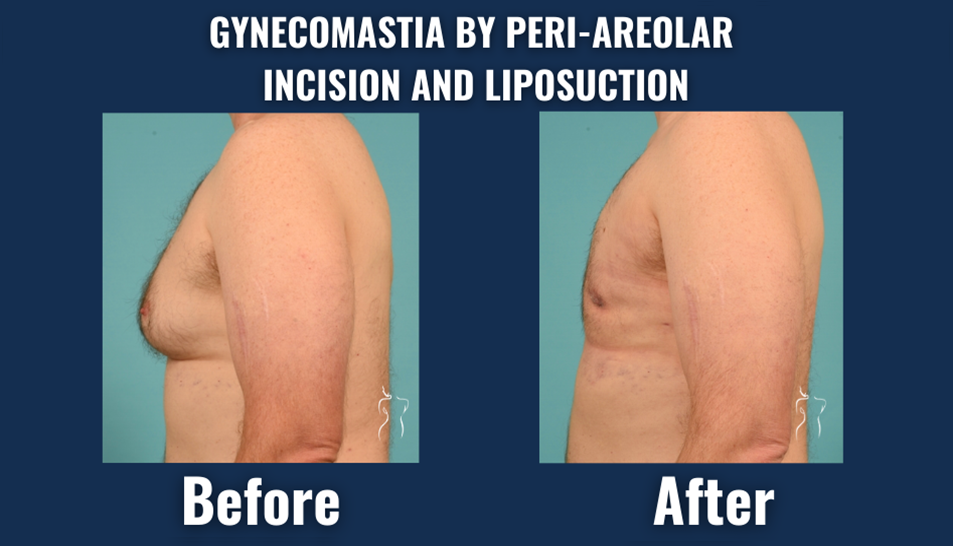
Gynecomastia surgery delivers long-lasting removal of breast glandular tissue — it does not grow back. Most patients experience a dramatic improvement in chest contour, with results that become fully apparent within three to six months as post-operative swelling subsides and skin fully contracts.
- Flat, firm, naturally masculine chest profile
- Reduced or eliminated nipple protrusion
- Improved definition of pectoral muscles
- Smooth skin contour with minimal, well-concealed scarring (incisions are small and strategically placed)
"Dr. Day performed two surgeries for me. Surgery can be scary, but both times he made sure to explain the procedure, the expected recovery, answer all questions, and put my mind at ease. My wife has seen my successes with Dr. Day, and is excited to become his patient as well."
— Garrett S., Surgical Patient • Google Review
Gynecomastia Surgery Cost in Bellevue
The cost of gynecomastia surgery varies based on the extent of tissue to be addressed, the technique or combination of techniques required (liposuction, excision, Renuvion, VASER), anesthesia, and facility fees. A personalized cost estimate is provided during your private consultation at Pacific Sound Plastic Surgery.
What Affects the Cost of a Gynecomastia Surgery?
- Grade of gynecomastia (I, IIa, IIb, III) — more extensive procedures require more surgical time
- Technique selected — Renuvion or VASER cases may carry additional technology costs
- Anesthesia type and duration
- Whether the procedure is combined with additional body contouring
What’s Included in Your Calf Augmentation Investment
Your surgical fee covers all of the following at Pacific Sound Plastic Surgery:
- Surgeon's fee
- Facility / operating room fee
- Anesthesia (administered by a board-certified anesthesiologist or certified registered nurse anesthetist)
- Enhanced Recovery After Surgery medication (Exparel)
- Cosmetic surgery insurance coverage (Cosmetasure)
- High-end compression garment (Isavella)
- High-end scar ointment (Biocorneum)
- Swelling and bruising ointment (Arnica)
- Clara Recovery Supplements
- Chlorhexidine Anti-Septic Scrub Cloths
- Post-operative recovery and follow-up care
Financing Options
Pacific Sound Plastic Surgery accepts CareCredit (6-month financing) and Alphaeon Credit, two of the most widely used healthcare financing programs. Both allow patients to begin their journey without paying the full cost upfront.
Starting from $6,500
Pricing is discussed in full detail during your consultation so there are no surprises. Call (425) 818-8991 to get started.
Why Choose Dr. Kristopher Day for Your Gynecomastia Surgery?
Choosing a surgeon for gynecomastia surgery requires more than reviewing before-and-after photos. It requires confidence in your surgeon’s credentials, judgment, and commitment to individualized care. Dr. Kristopher M. Day, MD, FACS brings a rare combination of advanced training, technical skill, and a patient-first approach to every procedure at our Bellevue practice.
- Double Board-Certified — American Board of Plastic Surgery (ABPS) + American Board of Surgery (ABS)
- Ivy League trained — a standard of academic excellence that informs every surgical decision
- 10+ years of experience in glandular excision and advanced body contouring with Renuvion and VASER
- Highly rated by patients — one of the highest patient satisfaction scores in Bellevue
- 30+ peer-reviewed publications — academic rigor applied to every surgical decision
- Surgical Facilities: Swedish Medical Center, Virginia Mason Franciscan Health, Carillon Point Surgery Center, Sound Plastic Surgery Center
- Private, boutique practice — personal care with no assembly-line patient volume
- Call (425) 818-8991 to speak with our team directly








Conveniently Located for Bellevue & Surrounding Communities
Pacific Sound Plastic Surgery is centrally located in downtown Bellevue, making Dr. Day’s fellowship-trained expertise accessible to families throughout Bellevue and the greater Eastside — without the stress of navigating Seattle traffic. Our patients enjoy a private, boutique surgical experience with on-site validated parking, just minutes from the communities they call home.
Seattle
~15 minutes
World-class plastic surgery results without the downtown Seattle parking hassle. A quick drive across SR-520 or I-90 to our private Bellevue office.
Kirkland
~10 minutes
Just minutes from downtown Kirkland and the Juanita waterfront via I-405 or surface streets.
Redmond
~10 minutes
Convenient for the Redmond tech community via SR-520 or surface streets.
Mercer Island
~10 minutes
A quick drive across I-90. Our discreet, private environment is ideal for discerning Mercer Island residents.
Issaquah
~10 minutes
Convenient for Issaquah Highlands and Gilman Village area families via I-90.
Renton
~5 minutes
Easy access from Renton and the Landing via I-405 North. Boutique care and personalized attention just minutes away.
Frequently Asked Questions
What is gynecomastia and how is it different from chest fat?
Gynecomastia is the benign enlargement of actual glandular breast tissue in males — distinct from pseudogynecomastia, which is an accumulation of fatty tissue. True gynecomastia involves a firm, rubbery disc of breast gland beneath the nipple-areola area that cannot be reduced through exercise or weight loss. Dr. Day evaluates both tissue types during your consultation to determine the most appropriate surgical approach.
Will gynecomastia surgery scars be visible?
Incisions for gynecomastia surgery are strategically placed to minimize visible scarring. For glandular excision, the incision is made along the lower edge of the areola (periareolar), where the color transition naturally camouflages the scar. Liposuction-only cases use tiny 2–3mm poke holes. Most patients find their scars fade significantly within 12 months and are not visible under normal clothing or at the beach.
How long does gynecomastia surgery take?
The procedure typically takes 2–3 hours, depending on the grade of gynecomastia and the techniques required. All procedures are performed on an outpatient basis under general anesthesia — you go home the same day.
Is gynecomastia surgery permanent?
Yes. The glandular breast tissue removed during surgery does not regenerate. Results are considered permanent provided you maintain a stable body weight and avoid medications or substances known to cause gynecomastia. Significant weight gain after surgery can affect the fatty component of the chest but will not regrow glandular tissue.
How painful is recovery from gynecomastia surgery?
Most patients describe recovery as mild to moderate discomfort in the first few days, managed comfortably with prescribed medication. The chest feels tight and tender, and a compression garment is worn for the first several weeks to support healing. The 23-and-3 Rule applies: wear the garment 23 hours per day (removing only to shower and wash), for a minimum of 3 weeks and ideally 3 months for optimal refinement. The majority of patients return to desk work within one week and resume full upper-body exercise at the 4–6 week post-operative visit.
What technologies does Dr. Day use for gynecomastia surgery?
Dr. Day uses Renuvion energy-based skin tightening and VASER ultrasound liposuction as adjunct technologies for appropriate gynecomastia cases. Renuvion delivers radiofrequency energy combined with helium plasma to contract overlying skin without additional incisions — particularly valuable for Grade IIb and III cases. VASER uses ultrasound to selectively emulsify fat for gentler, more precise removal. Not every patient needs these technologies; Dr. Day will assess your skin elasticity and tissue composition during your consultation and recommend the approach that will produce the best result for your anatomy.
Does insurance cover gynecomastia surgery?
In most cases, gynecomastia surgery is considered cosmetic and is not covered by insurance. However, if there is a documented underlying medical cause (such as medication-induced gynecomastia, hypogonadism, or a hormonal disorder) and associated symptoms like pain or tenderness, partial insurance coverage is sometimes possible. If you would like your case to be considered for insurance coverage, a primary care doctor’s documented referral is required. Our patient care coordinator can help navigate your specific situation during your consultation.
What is the difference between gynecomastia surgery and top surgery?
Gynecomastia surgery is designed for cisgender males with enlarged breast tissue, with the goal of restoring a masculine chest contour while preserving the nipple-areola complex in its natural position. Gender-affirming top surgery (FTM/non-binary) is designed for transgender and non-binary patients and may involve different incision patterns, nipple repositioning, and different goals. Both procedures are performed by Dr. Day at Pacific Sound Plastic Surgery, but the techniques and consultations are distinct.
Can I combine gynecomastia surgery with other procedures?
Yes, many patients choose to combine gynecomastia surgery with liposuction of the abdomen, flanks, or sides for more comprehensive body contouring. Combining procedures is performed under one anesthesia, which reduces overall downtime and cost. Dr. Day will discuss combination options during your consultation based on your goals and medical fitness.
How do I know if I have true gynecomastia or just chest fat?
The key differentiator is a firm, rubbery disc of tissue directly beneath the nipple that feels different from surrounding fatty tissue. You may also notice breast tenderness or sensitivity. A definitive evaluation is only possible through a consultation and physical exam — Dr. Day can assess whether you have glandular gynecomastia, pseudogynecomastia (fatty), or a combination, and recommend the appropriate treatment.
How do I get started with gynecomastia surgery in Bellevue?
The first step is a private consultation at Pacific Sound Plastic Surgery. Dr. Day will examine your chest, review your health history, discuss your goals, and provide a personalized surgical plan and cost estimate. Call our Bellevue office at (425) 818-8991 to schedule — or use the online booking form on our website.
How soon can I exercise after gynecomastia surgery?
Light walking is encouraged starting the day after surgery. Lower-body cardio such as walking and cycling can typically resume around weeks 1–2. Upper-body exercise and chest-focused gym work is generally cleared at the 4–6 week post-operative visit, once healing is confirmed. A compression garment is typically worn for at least 3 to 12 weeks.