Fluid Drainage After Liposuction

Liposuction: Everything You Need to Know for a Safe and Successful Recovery

At Pacific Sound Plastic Surgery in Bellevue, Washington, we understand that liposuction is more than just a cosmetic procedure—it’s an opportunity to enhance your body’s contours and boost your confidence. Whether you’re aiming to refine specific problem areas or seeking fat for grafting into other parts of your body, liposuction offers a transformative solution. Here’s what you need to know about the procedure, different techniques, and recovery to ensure a smooth and successful experience.

Body Shaping Spa And Slimming. Closeup cropped of unrecognizable fit woman wearing lingerie pulling up white panties standing isolated on pastel studio background. Torso of slim female with lines

What Is Liposuction?

Liposuction is a popular body contouring procedure designed to remove excess fat from areas that are resistant to diet and exercise. It is commonly performed on areas like the abdomen, thighs, arms, back, and chin. Liposuction isn’t intended for weight loss but for sculpting and reshaping the body to achieve more balanced, proportionate contours. Additionally, the fat removed during liposuction can sometimes be used for fat grafting, a process where fat is transferred to other areas of the body, such as the face or buttocks.

Types of Liposuction at Pacific Sound Plastic Surgery

There are several liposuction techniques, each designed to address different aesthetic needs and body types. Your surgeon will help determine which method is best for you based on your specific goals.

  1. Tumescent Liposuction
    • What It Is: The most common method, where a saline solution containing lidocaine (local anesthetic) and epinephrine (a vasoconstrictor) is injected into the fat to minimize bleeding, reduce pain, and make fat easier to remove.
    • How It Works: The fat is suctioned out through a small tube (cannula) attached to a vacuum-like device.
  2. Ultrasound-Assisted Liposuction (UAL)
    • What It Is: Uses ultrasound energy to liquefy fat before it is suctioned out, making it ideal for firmer, fibrous fat areas like the male chest or back.
    • How It Works: The ultrasound waves break down fat cells, reducing trauma to the surrounding tissue.
  3. Laser-Assisted Liposuction (SmartLipo)
    • What It Is: Involves a laser fiber that melts fat while stimulating collagen production for tighter skin.
    • How It Works: Ideal for smaller, delicate areas like the neck, face, or arms, this method can provide both fat removal and skin tightening benefits.
  4. Power-Assisted Liposuction (PAL)
    • What It Is: A vibrating cannula that breaks up fat cells more efficiently with less force, reducing the amount of effort required by the surgeon.
    • How It Works: The vibration helps minimize bruising and allows for more precise fat removal, promoting quicker recovery.
  5. Water-Assisted Liposuction (BodyJet)
    • What It Is: Uses a stream of water to dislodge fat, which is then suctioned away. This method is gentle on surrounding tissues and offers a less traumatic approach to fat removal.
    • How It Works: The water jet loosens fat cells, which are then easily removed, resulting in less swelling and a faster recovery.

How Much Fat Can Be Removed?

Typically, liposuction involves the removal of up to 5 liters (about 11 pounds) of fat during a single session. While the goal of liposuction is to sculpt and contour the body rather than promote weight loss, significant fat removal is possible for patients who are close to their ideal weight. Surgeries involving more than 5 liters of fat may increase the risk of complications such as blood loss, fluid imbalance, and anesthesia-related issues, so these are usually avoided unless specifically necessary.

Ensuring Symmetry and Precision

Our surgeons at Pacific Sound Plastic Surgery are experts in creating natural-looking results with smooth, symmetrical contours. To achieve this, we carefully plan the areas to be treated prior to surgery and use advanced techniques such as 3D imaging during the procedure to ensure balance and symmetry. In addition, the tumescent solution used during the procedure helps minimize bleeding and provides a more precise removal of fat, ensuring your results are as expected.

Fat Grafting: Reusing Fat for Volume Enhancement

Sometimes, the fat removed during liposuction is used for fat grafting, also known as autologous fat transfer. This technique involves taking fat from one part of your body and injecting it into another area to restore volume or improve contours. Common areas for fat grafting include:

  • Face: For areas like the cheeks or under-eye hollows
  • Breasts: As a filler after breast augmentation or reconstruction
  • Buttocks: As part of a Brazilian Butt Lift (BBL) procedure

Fat grafting is often preferred over synthetic implants because it’s natural, reduces the risk of allergic reactions, and provides long-lasting results. However, some of the fat may be reabsorbed by your body over time, which is normal.

Post-Surgery Fluid and Oozing

After liposuction, it’s normal to experience fluid drainage from the incision sites. This fluid is a combination of tumescent solution, which helps minimize bleeding and pain during the procedure, and natural fluids your body releases as part of the healing process. The oozing can last up to 24-48 hours post-procedure and is nothing to be concerned about, as long as the patient’s vital signs remain stable. In some cases, postoperative drains may be used to prevent fluid buildup, but they are not always necessary.

Signs of Complications to Watch For

While complications after liposuction are rare, it’s important to be aware of any unusual symptoms. Call your surgeon immediately if you experience:

  • Infection: Increased redness, swelling, fever, or foul-smelling drainage
  • Hematoma or Seroma: Excessive blood or fluid accumulation that causes a bulging or painful area
  • Fat Embolism: Difficulty breathing, chest pain, or confusion (this is a rare but serious condition)
  • Excessive Bleeding: Persistent bleeding or drainage beyond what is expected
  • Skin Irregularities or Necrosis: Discoloration, blisters, or ulcers on the skin indicating possible issues with circulation or fat removal

What to Expect After Liposuction Surgery

Your post-surgical care is key to achieving the best possible results from your liposuction procedure. Here’s a breakdown of important steps for your recovery:

  1. Compression Garments: Wearing compression garments as directed is essential for reducing swelling, helping with skin retraction, and improving the contour of the treated area.
  2. Hydration and Nutrition: Stay hydrated and maintain a healthy diet to support healing and minimize swelling.
  3. Activity Restrictions: Avoid vigorous activities for the first 1-2 weeks. Most patients can resume light activities after a couple of days.
  4. Incision Care: Keep your incisions clean and dry. If drains are used, follow your surgeon’s instructions on how to care for them.
  5. Watch for Complications: Be aware of any signs of infection or unusual swelling and contact your surgeon if you have any concerns.

Managing Pain and Discomfort

Most patients experience some discomfort as the numbing effect from the lidocaine wears off. Pain medication will be prescribed to manage any post-operative pain. We recommend following your surgeon’s instructions on how to take pain medications for the best results.

Follow-Up Appointments

To monitor your progress and ensure that you’re healing well, follow-up appointments are essential. During these visits, your surgeon will evaluate the symmetry of your results, check for any complications, and provide additional guidance for your recovery.

Final Thoughts

Liposuction is a powerful tool for sculpting your body and achieving the contours you’ve always wanted. At Pacific Sound Plastic Surgery, our team is committed to providing a safe, comfortable experience and ensuring that you achieve the best possible results. If you’re considering liposuction, we’re here to guide you every step of the way, from preoperative planning to postoperative care.

If you’re ready to take the next step in your body transformation, contact us today to schedule a consultation. Let’s work together to help you achieve your aesthetic goals and feel confident in your own skin.

Different Types of Liposuction: What is Important?

Areas Treated by Liposuction 2-13-2023 KD DIFFERENT TYPES OF LIPOSUCTION:
Liposuction, or “suction-assisted lipoplasty,” refers to a procedure where fat cells are suctioned out of the body through small access points using a cannula that is attached to suction. That is probably the most basic description of “conventional liposuction.” There are, however, a number of other types of liposuction that most people have heard about, which use ultrasound, laser, heat, radiofrequency, and other additional treatments along with suctioning out fat cells. Then there are techniques, such as high-definition and other terms that are simply proprietary labels that companies have put on their different versions of the above, many of which have never been shown to be different than other versions of liposuction. So how does one make sense of it all? Well, the truth is probably that there are some benefits from additional variants of the “normal” liposuction, but like a lot of things, it’s not the variant that is important but the fundamentals that make a bigger difference.

Some of the fundamentals that make liposuction results best include the use of appropriate amounts of wetting solution, which is the fluid that is injected to get the fat cells out. This must be measured for safety, because this solution has medication in it that must be proportioned to each patient. The cannula that is selected is also important, because too large a cannula could cause contour problems. Using multiple access points allows for crisscrossing the pattern of fat removal for a smooth result. Also, keeping in mind how much removal a patient can tolerate safely during a given liposuction treatment is important, as there is fluid shift experienced by the patient. Many states limit a maximal amount of liposuction during one session to certain maximums to minimize complications. The anesthetic is also important, since liposuction can often be safely performed either under general anesthesia, moderate or “twilight” anesthesia, or awake with local anesthesia. Most often liposuction is performed under general anesthesia, and this is also a mark of accredited surgical facilities if they offer this option.

So before getting confused by trade names like “TriSculpt” or “Micro-Body Contouring” or “AirSculpt,” focus instead of the fundamentals, experience, and how much of connection you form with your surgeon during a consultation. These terms are generally not validated in any peer-reviewed literature, so may mean very little for the result that is achieved for you in your procedure.

Liposuction can treat the abdomen, hips, flanks, back, arms, legs, neck and other areas of the body. It is used as both an independent treatment as well as in conjunction with other treatments, such as during a “lipoabdominoplasty” or using liposuction as an adjunct treatment to harvest fat during fat grafting (e.g, a “BBL” or Brazilian butt lift), or in contouring areas of the body adjacent to the primary surgical area. Most liposuction procedures are performed in ambulatory surgical centers with same-day discharge and recovery at home. It is common to have fluid drainage, swelling, and bruising, but the recovery is generally well-tolerated. Fat removal from liposuction is permanent and will not cause accumulation of fat in other areas. Contour garments, postoperative optimization of nutrition and judicious exercise, and toning efforts further enhance results.

If you would like to learn more about liposuction, reach out to us at Pacific Sound Plastic Surgery by emailing Info@PacificSoundPlasticSurgery.com or by calling 425-818-8991 to schedule a consultation.

Abdominal Contouring and the Difference Between an Abdominoplasty and a Panniculectomy

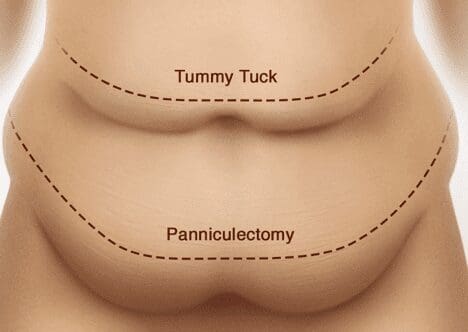
Tummy Tuck Vs Panniculectomy

ABDOMINAL CONTOURING OPTIONS: WHAT IS THE DIFFERENCE BETWEEN A TUMMY TUCK AND A PANNICULECTOMY?

Maybe you are a hard-working mom of two who wants to get rid of the fold of skin in your lower abdomen, or you are a middle-aged man that had large weight loss after bariatric surgery with redundant skin folds, or you’re a young person who has worked hard on your diet but have extra lower abdomen tissue that gets in the way when exercising. Abdominal contouring surgery is commonly pursued following childbirth, significant weight loss, or when diet and fitness efforts fail to eliminate loose tissues of the belly. Excess fat that overhangs one’s pants, causes back pain, or prevents participation in activities is a nuisance that you don’t have to live with. But what is the procedure called to remove it? Well, there may be multiple options, but essentially there are likely two major different types of excisional (or tissue removal) ways to treat extra lower abdominal tissue: tummy tuck (or abdominoplasty) and panniculectomy. This describes the general concepts about which you may need.

An abdominoplasty, or tummy tuck, not only removes the extra skin and soft tissue of the lower abdomen but can also further shape the upper abdomen and lateral flanks with liposuction, as well as tighten the deep abdominal wall with what is called a “rectus plication.” So, while an abdominoplasty removes extra tissue in the vertical direction, this combination of procedures also improves the horizontal contour as well. A tummy tuck is fundamentally an aesthetic procedure that is meant to improve the appearance of the entire abdomen. It is virtually never covered by insurance and is typically performed in an ambulatory surgical center.

Unfortunately, sometimes an abdominoplasty is not an option for some patients. This is to mitigate risk of complications after an abdominoplasty, which is a larger surgery with greater risk for less-than-ideal surgical candidates. The most common limiting factor is usually body-mass index (BMI), which is a ratio of a patient’s weight to their height, which if over 35 (or ideally 30), prevents performing a tummy tuck. Medical issues that are less well-controlled, advanced age, abdominal scarring or other suboptimal soft tissue issues may be other reasons that prohibit an abdominoplasty.

A panniculectomy can be thought of as a “half-abdominoplasty.” This is a procedure that only treats the lower half of the abdominal tissue by removal of the excess skin and soft tissue of the lower abdominal fold. This can help with the elimination of skin-to-skin contact regions (or “intertriginous tissue”) so that rashes, ulceration areas, fungal infections, and other skin issues may be eliminated. Panniculectomy is designed to help with the contour of the lower abdomen and does not improve the shape of the upper abdomen or tissue around the belly button. The lower abdominal tissue only is removed in a panniculectomy, and the belly button, or umbilicus, is left in its native location. No rectus muscle plication, or deep “fascia” level tightening is conducted in this procedure, nor is there any upper abdominal contouring involved. Panniculectomy also does not treat the deep layers, such as the strong tissue called fascia that lies over the abdominal muscles and can cause a “rectus diastasis,” or pseudo-hernia, of the abdominal wall, which are typically repaired during an abdominoplasty. Liposuction is also not used typically during a panniculectomy, so there is little lateral abdominal contouring during a panniculectomy. It is simply the removal of the fold of excess skin and fat of the lower abdomen. While there is less cosmetic benefit from panniculectomy, it is the safer procedure for some patients and panniculectomy does not prevent a future abdominoplasty.

If you are interested in an abdominal contouring procedure but do not know which you are a candidate for, then feel free to reach out for a consultation. Dr. Day has extensive experience in abdominoplasty, panniculectomy, and a range of other abdominal contouring techniques and will design a customized approach to help you achieve your best results!

Lipo 360

Latin woman in baggy pants, indoors, over a white wall. Weight loss concept.

WHAT IS A 360-DEGREE LIPOSUCTION?

The term “360-Degree Liposuction” describes conducting suction lipectomy (another name for liposuction) all the way around the waist. This targets removal of upper back or bra roll, lower back, anterior and posterior hip, mons pubis, and abdomen fat to achieve a more contoured waistline. This “Lipo 360” can thereby achieve a more sculpted waistline that also impacts the S-curve contour of the flank region of the body so that the lower hips and buttock appear fuller compared to the abdomen, love handles, and waistline. The procedure is a less-invasive option to achieve abdominal rejuvenation without the scar that is associated with an abdominoplasty or belt lipectomy. Lipo 360 may be readily combined with a buttock augmentation, Brazilian Butt Lift (or “BBL”), which uses the fat removed to increased buttock size, contour, and projection.

The best candidates for a 360-degree liposuction are patients that need some additional help removing residual fat after diet and exercise have fallen short in patients that are not ready to undergo an abdominoplasty, or do not have significant excess skin and soft tissue. In the right patient, a Lipo 360 can deliver:

  • Elimination of excess fat along the belt line
  • More hourglass contour of the trunk
  • Deceased prominence of the hips, saddle bags, abdomen, and mons pubic regions
  • Improved fit of clothing at the waist
  • Increased self-confidence

If you are interested in a Lipo 360, remember that this is a surgical procedure and you should expect some recovery time. 360-degree liposuction is usually performed by plastic and reconstructive surgeons. In good candidates, it can be performed as an outpatient in an ambulatory surgical center, though recovery time is often proportional to the amount of fat removed. Patients who undergo a 360-degree liposuction often experience an uplifted outlook and renewed motivation for further physical fitness and toning.

If you would like to learn whether you are a candidate for a Lipo 360, don’t hesitate to ask Kristopher M. Day, MD, FACS by emailing

Info@PacificSoundPlasticSurgery.com to schedule a complementary consultation. Dr. Day has extensive experience in all varieties of abdominal rejuvenation, including 360-degree liposuction, and looks forward to discussing your personal goals!