
Abdominal Contouring and the Difference Between an Abdominoplasty and a Panniculectomy

Tummy Tuck Vs Panniculectomy

ABDOMINAL CONTOURING OPTIONS: WHAT IS THE DIFFERENCE BETWEEN A TUMMY TUCK AND A PANNICULECTOMY?

Maybe you are a hard-working mom of two who wants to get rid of the fold of skin in your lower abdomen, or you are a middle-aged man that had large weight loss after bariatric surgery with redundant skin folds, or you’re a young person who has worked hard on your diet but have extra lower abdomen tissue that gets in the way when exercising. Abdominal contouring surgery is commonly pursued following childbirth, significant weight loss, or when diet and fitness efforts fail to eliminate loose tissues of the belly. Excess fat that overhangs one’s pants, causes back pain, or prevents participation in activities is a nuisance that you don’t have to live with. But what is the procedure called to remove it? Well, there may be multiple options, but essentially there are likely two major different types of excisional (or tissue removal) ways to treat extra lower abdominal tissue: tummy tuck (or abdominoplasty) and panniculectomy. This describes the general concepts about which you may need.

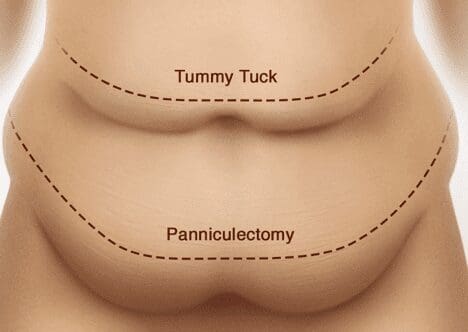
An abdominoplasty, or tummy tuck, not only removes the extra skin and soft tissue of the lower abdomen but can also further shape the upper abdomen and lateral flanks with liposuction, as well as tighten the deep abdominal wall with what is called a “rectus plication.” So, while an abdominoplasty removes extra tissue in the vertical direction, this combination of procedures also improves the horizontal contour as well. A tummy tuck is fundamentally an aesthetic procedure that is meant to improve the appearance of the entire abdomen. It is virtually never covered by insurance and is typically performed in an ambulatory surgical center.

Unfortunately, sometimes an abdominoplasty is not an option for some patients. This is to mitigate risk of complications after an abdominoplasty, which is a larger surgery with greater risk for less-than-ideal surgical candidates. The most common limiting factor is usually body-mass index (BMI), which is a ratio of a patient’s weight to their height, which if over 35 (or ideally 30), prevents performing a tummy tuck. Medical issues that are less well-controlled, advanced age, abdominal scarring or other suboptimal soft tissue issues may be other reasons that prohibit an abdominoplasty.

A panniculectomy can be thought of as a “half-abdominoplasty.” This is a procedure that only treats the lower half of the abdominal tissue by removal of the excess skin and soft tissue of the lower abdominal fold. This can help with the elimination of skin-to-skin contact regions (or “intertriginous tissue”) so that rashes, ulceration areas, fungal infections, and other skin issues may be eliminated. Panniculectomy is designed to help with the contour of the lower abdomen and does not improve the shape of the upper abdomen or tissue around the belly button. The lower abdominal tissue only is removed in a panniculectomy, and the belly button, or umbilicus, is left in its native location. No rectus muscle plication, or deep “fascia” level tightening is conducted in this procedure, nor is there any upper abdominal contouring involved. Panniculectomy also does not treat the deep layers, such as the strong tissue called fascia that lies over the abdominal muscles and can cause a “rectus diastasis,” or pseudo-hernia, of the abdominal wall, which are typically repaired during an abdominoplasty. Liposuction is also not used typically during a panniculectomy, so there is little lateral abdominal contouring during a panniculectomy. It is simply the removal of the fold of excess skin and fat of the lower abdomen. While there is less cosmetic benefit from panniculectomy, it is the safer procedure for some patients and panniculectomy does not prevent a future abdominoplasty.

If you are interested in an abdominal contouring procedure but do not know which you are a candidate for, then feel free to reach out for a consultation. Dr. Day has extensive experience in abdominoplasty, panniculectomy, and a range of other abdominal contouring techniques and will design a customized approach to help you achieve your best results!


Insurance Coverage for Plastic Surgery

Health Insurance Cartoon

WHAT PLASTIC SURGERY IS COVERED BY INSURANCE?

Most people relate plastic surgery to cosmetic, or aesthetic, surgery exclusively. This is not a complete picture. Plastic and reconstructive surgeons perform all sorts of procedures, such: as breast reconstruction after a mastectomy for cancer, tendon reconstruction after a traumatic hand injury, or reconstruction of a leg wound after chronic vessel disease. None of these procedures would be considered cosmetic, and most insurances would fund the payment for the purpose of enhanced function. Strictly form-related conditions, however, are mostly not paid for by most insurance companies, unless that form-related condition is associated with other symptoms that limit a person’s function in a meaningful way that could be improved with plastic surgery. To understand the difference, one can compare a few procedures of the breast: breast reduction, breast lift, and breast reconstruction (after cancer).

Breast reduction, or reduction mammoplasty, and breast lift, or mastopexy, are two of the most common procedures in plastic surgery. Larger-than-desired breasts can cause neck and back pain, grooving where the bra strap sits, social self-consciousness, and impair activities like running and dancing. A breast reduction is the removal of breast tissue to result in a smaller breast. This is different than a breast lift, which also requires the removal of some tissue, but generally much less and only for the purposes of lifting, not to remove tissue or make the breast smaller. This is a key distinction because a breast lift is essentially never covered by insurance. However, a breast reduction is sometimes covered by insurance if certain criteria are met, such as taking off enough tissue to qualify the procedure as a reduction. While not all breast lifts involve size reduction, all breast reductions include a breast lift. The guidelines for how much is required to call a procedure a reduction in the eyes of an insurance company is determined by a patient’s height, weight, “body mass index,” and body surface area. This is outlined in the Schnur Scale, which is a list of breast tissue removal weights that are required to qualify for an insurance-covered breast reduction. So you basically have to have at least the mount to meet the Schnur Scale for an insurance-covered breast reduction.

Now compare the above to breast reconstruction. The Women’s Health and Cancer Rights Act of 1998 requires all group health plans that pay for mastectomy to also cover prostheses and reconstructive procedures. So, assuming you haven’t chosen a reconstructive procedure that varies from the standard of care, are working with a plastic surgeon outside of your health network or have some special exception in your plan (which your plan administrator could explain), then in virtually all cases the reconstruction after the removal of your breast tissue by mastectomy for cancer should be covered by insurance.

There are several other conditions in which insurance may or may not cover your procedure, such as panniculectomy (sometimes covered) versus tummy tuck (generally not covered). A panniculectomy is the removal of tissue from the lower abdomen for reasons of reconstruction to remove excess skin that may cause dermatologic problems and/or back pain. It does not include tightening of the deep abdominal wall, or a “rectus muscle plication,” or the repositioning of the belly button. A tummy tuck includes these techniques for the purposes of not only removing extra skin and soft tissue of the lower abdomen but also to make the upper abdomen and flanks look better. A tummy tuck sometimes includes liposuction, whereas a panniculectomy involves only direct excision of tissue.

If you would like to learn more about whether a surgical procedure you have been considering might qualify for insurance coverage, reach out to Kristopher M. Day, MD, FACS by emailing Info@PacificSoundPlasticSurgery.com to schedule a consultation. Dr. Day has extensive experience in many conditions for the improvement or both form and function and looks forward to speaking with you about your goals!

Breast reduction, or reduction mammoplasty, and breast lift, or mastopexy, are two of the most common procedures in plastic surgery. Larger-than-desired breasts can cause neck and back pain, grooving where the bra strap sits, social self-consciousness, and impair activities like running and dancing. A breast reduction is the removal of breast tissue to result in a smaller breast. This is different than a breast lift, which also requires the removal of some tissue, but generally much less and only for the purposes of lifting, not to remove tissue or make the breast smaller. This is a key distinction because a breast lift is essentially never covered by insurance. However, a breast reduction is sometimes covered by insurance if certain criteria are met, such as taking off enough tissue to qualify the procedure as a reduction. While not all breast lifts involve size reduction, all breast reductions include a breast lift. The guidelines for how much is required to call a procedure a reduction in the eyes of an insurance company is determined by a patient’s height, weight, “body mass index,” and body surface area. This is outlined in the Schnur Scale, which is a list of breast tissue removal weights that are required to qualify for an insurance-covered breast reduction. So you basically have to have at least the mount to meet the Schnur Scale for an insurance-covered breast reduction.

Now compare the above to breast reconstruction. The Women’s Health and Cancer Rights Act of 1998 requires all group health plans that pay for mastectomy to also cover prostheses and reconstructive procedures. So, assuming you haven’t chosen a reconstructive procedure that varies from the standard of care, are working with a plastic surgeon outside of your health network or have some special exception in your plan (which your plan administrator could explain), then in virtually all cases the reconstruction after the removal of your breast tissue by mastectomy for cancer should be covered by insurance.

There are several other conditions in which insurance may or may not cover your procedure, such as panniculectomy (sometimes covered) versus tummy tuck (generally not covered). A panniculectomy is the removal of tissue from the lower abdomen for reasons of reconstruction to remove excess skin that may cause dermatologic problems and/or back pain. It does not include tightening of the deep abdominal wall, or a “rectus muscle plication,” or the repositioning of the belly button. A tummy tuck includes these techniques for the purposes of not only removing extra skin and soft tissue of the lower abdomen but also to make the upper abdomen and flanks look better. A tummy tuck sometimes includes liposuction, whereas a panniculectomy involves only direct excision of tissue.

If you would like to learn more about whether a surgical procedure you have been considering might qualify for insurance coverage, reach out to Kristopher M. Day, MD, FACS by emailing Info@PacificSoundPlasticSurgery.com to schedule a consultation. Dr. Day has extensive experience in many conditions for the improvement or both form and function and looks forward to speaking with you about your goals!